Sunday, November 20, 2016

Can't We Talk About Something More Pleasant? by Roz Chast


by


The December selection for my local library reading group is a graphic novel about caring for aging parents.  It is called Can't We Talk About Something More Pleasant and is written by a cartoonist for The New Yorker by the name of Roz Chast.  Her parents were both the children of poor Russian Jewish immigrants.  They lived into their 90's and in the book the author has to navigate the health care system for elders in 21st century America.  Since I worked most of my nursing career in long term care facilities I was able to really get what she was talking about.  This is the first graphic novel I have ever read and I found it hard to get the hang of at first.  I expected to have problems so instead of getting the book on my kindle or in audio form I actually checked out a hard back copy of the book at the local library during the book group meeting for November.   It did take me quite a few pages to get the hang of the order of the cartoons.  But I enjoyed the format once I got the format figured out.  This  is a worth while book to read if you are going through dealing with aged parents.  It also might help open up some dialog for those that want to get family members talking about end of life decisions.   Please click on the book title and author's name above to follow the links to more information and enjoy the video that follows.  


Tuesday, November 15, 2016

On Writing Well by William Zinsser


by


As a teenager I wrote a lot of bad poetry.   And the last several years I have played around with my blog.  First on Yahoo360 and then on Multiply.  When those sites closed I moved to Blogger.   And while I do not get many comments I am always surprised at the number of  page views to my posts.  This past March when my three months in the recliner started with both bones broken in my lower leg, I got aspirations that maybe I would like to be prepared to enter some of the writing contests that I was seeing announced at that time by the time the 2017 contests were announced.  I began to gather information on a couple of my family  lines that seemed like interesting ones to write about and at the end of August for my birthday gift to myself I purchased and participated in a six week creative family history writing workshop that can be found at this SITE.  One of the many resources provided at The Family History Writing Studio is a book list of recommended reading.  One of the books that was recommended that I could check out from the State Of Ohio library on my kindle was the classic book On Writing Well by William Zinsser.   I finished reading the book in the night last night and found a lot of useful information in it.  I did find myself skimming through parts of it that did not apply to my interests and concentrating on the parts of the book that applied to my aspirations.  I do not have any desire to be a full time writer.  I don't even care if I win the contests I enter.  I just do not want to send in an entry that I am not happy with.   The course I took this September and October convinced me that "creative non fiction" is not my genre although I do think elements of it are things I will use a lot and the organizational skills I learned for putting together my writing are going to be invaluable.  In addition there were check lists provided that will facilitate exactly the items I want to research to find the information I want to include in my pieces.   William Zinsser's book also provided information that I will use on how to proceed and some pitfalls to avoid.  I do not know whether this is a book that people who normally read my blog for reading ideas will be interested in, but it is a book I would recommend if a person is trying to polish their writing craft and has not yet read it.  Please click on the links above and enjoy the video below presented by the author.  


Friday, November 4, 2016

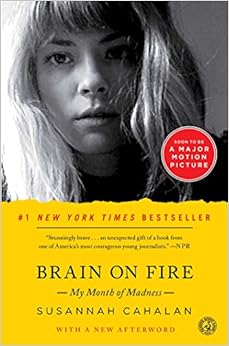
Brain On FIre: My Month of Madness by Susannah Cahalan


by

Library reading groups provide a couple of things to me.  One is a social group to attend but another is that the books that we read are often books that I would never choose.  Therefore to be involved in the group stretches me to new experiences and new ways of thinking.  A good example of this is the book that is the selection for my local library's reading group in November.   Susannah Cahalan's memoir Brain On Fire: My Month of Madness is not a book that would end up on my wish list.  I listened to it on audio and spent a good bit of the first two thirds of the book rolling my eyes as I drove to and from work.   Her symptoms were so obviously psychotic and as new symptoms showed up any nurse who had ever performed an AIMS assessment  would have asked the docs if they wanted to adjust her medication due to her EPS symptoms.   I envisioned a young woman who had pretty darn good insurance at her job at a New York City newspaper and had parents who both were very well off, admitted to The University Of New York Medical Center and burning through a million dollars because her friends and family could not accept a psychiatric diagnosis.  But well into the second half of the book something happened to open my mind and I was able to make the connection between auto immune disease and behavior.  After that I thought of the progress being made with cancer and our immune system.  Then my brain jumped to dementia and other forms of mental illness and the hope that perhaps as time went on more connections would be made between some psychotic symptoms and various auto immune diseases.   For several months I have been excited about the work that is taking place involving cancer, the immune system and genetic research.  Since reading this book that excitement has been extended from my hopes for the future on the oncology floors to my hopes for future on the psychiatric wards.   Susannah was in extremely fortunate circumstances and the fact that a particularly bright  Syrian immigrant physician was there to connect the proper dots was very lucky.  She realizes that the average person in America who would be admitted to the hospital with her symptoms would not get the same diagnosis but instead would get a one way ticket to a state hospital.   As a result she has re-dedicated her life to getting the word out about her disease.  This book is not an easy one to get through.   A young woman with psychotic behavior is upsetting to visualize.  But it is a book about a cutting edge medical breakthrough that is important to be aware of.   Please follow the links above and enjoy the video that follows to learn more about Anti-NMDA-Receptor auto immune encephalitis.  


Monday, October 31, 2016

The Dust That Falls From Dreams by Louis de Bernieres


by


This novel was reviewed in TIME Magazine quite some time ago and had been on my wish list to read ever since.  I discovered it was available to check out on my kindle from the State Library of Ohio so I was able to obtain it that way.  It is a very well written book and has been excellently researched historically but I found I really waded through it.  I enjoyed the story line and appreciated the fine writing but it was a bit over my head.  I am used to being able to touch a word on my kindle when I don't know what it means and the dictionary pops the definition up and I can read it and move on.   With this novel there were many words I didn't understand and when I touched the words the dictionary popped up "not found".  I am pretty sure they were British slang words that were popular during the early 20th Century.   There was also a lot of military information as far as aviation and weaponry that went over my head.  One of the main characters was half British and half French so he would throw French phrases out that I didn't understand.   Nevertheless,  I was able to glean enough out of the book to enjoy the story line and get an excellent picture of what life was like during WWI.  It did take me a long time.  I had to renew the book two or three times.  The novel is about a group of neighborhood children who come of age as WWI begins and how they made it through - or don't make it through - and for those that did survive, their struggle in the aftermath to put their lives in order.   I really felt as if I was in the trenches with the soldiers,  in the hospitals with the nurses,  and I could easily empathize as the young people mourned their friends and struggled to move on.   It is an excellent book and I recommend it with some caution.  If you are smarter than me,  if you are a man who is familiar with weapons and aviation,  or if like me you are motivated to struggle a bit,  this book is well worth the effort.  If you are more faint at heart and prefer fluff stories then I suggest you pass on this one.  Please click on the title and author's name above to follow the links for more information.  And please take time to enjoy the video interview of the author below.  


Saturday, October 22, 2016

Saturday Night Genealogy Challenge 10/22/16


My grandmother Doris Shively Whitehouse and I before a Mother/Daughter banquet
circa 1967


This week's challenge question is:  When you reflect back as a child, do you now see things that you did then, that show your interest in knowing extended family and/or your future interest in genealogy?  In order to see the other participants links and comments click HERE.  

The short answer for me is no.  But I was lucky since both of my parents parents divorced and remarried so I had twice as many grandparents as my friends.  As a result,  extended family was always a part of my life.  There were family gatherings with aunts, uncles and cousins a few times each year.   So I didn't have a specific interest but it was just normal to know them.  I have mentioned before in earlier challenges that my mother was interested in genealogy and drug us around to cemeteries when we were kids.  We were made to help find the stones she was looking for.  I hated it at the time but look back on those memories as good ones.  Also, once,  when I was about ten,  there was a mother and daughter banquet at the church my family was attending and we were to have wedding dresses modeled of several historical time periods.  My grandmother had her grandmother's wedding dress.  At age ten I was the only one in the family small enough to fit into the dress so I got to model it.  This was a really big deal to me.  See the picture at the beginning of this blog.  My sister and I have since donated the dress to the Miami County Museum in Peru Indiana.  Another interest that I had as a child that is related would be an early appreciation for history.  I loved to read as a child and my favorite books were the pioneer stories of the Oregon Trail.   Therefore,  while the short answer remains no to the question, the long answer is that I was exposed to things as a young person, and had related interests so that ending up with an passion for family history is not that far fetched of a result.  

Friday, October 21, 2016

The Guernsey Literary and Potato Peel Pie Society by Mary Ann Shaffer


and
Potato Peel Pie Society 
by
and 
Annie Barrows

 The library monthly daytime reading group at my local library that I attend read this delightful book this month.  I had read it back in 2010 and reviewed it HERE.   I listened to it on audio CD then and I listened to it on my iPod this time.  It is very nicely read by multiple voices in the audio version of the book.   The novel is about the occupation of the Island of Guernsey during WWII.  It is a series of letters from the islanders to an author.  The friendship that forms between the author and the islanders  makes for a warm story that also teaches the reader what it was like for people to struggle  to survive  during the occupation.   This book is one of those that sticks with you.  I was glad for the opportunity to listen to it again.  For those that like love stories,  for those that like historical novels,  for those that are WWII history buffs - this is the book for you.  Please follow the links in this blog post for more information and enjoy the video that follows.  


SaveSave

Saturday, October 8, 2016

The "Which Relative Gave you Family Information" Challenge


Alice Wilson Rohrer
1886-1978
Center


The challenge states:   Was there a relative that was a big help in giving you family information?  Who and how was he/she helpful? and can be found HERE along with comments and the links to the posts of others who participated in the challenge.  

Alice Rohrer was the woman I knew as my great grandmother.    I featured her during March when I was honoring women in my family history for women's history month.  That post can be found HERE.   The woman who gave birth to my grandfather was dead two weeks after he was born.  Four and a half years after that my great grandfather married the person I grew up calling "Grandma Al".   I can't say that she furnished me with organized family history but she was quick to share fun stories.  She explained a great deal about how life was on the farm in the early 1900s and she also shared a morsel or two of family gossip here and there.  One of the most helpful things she did was keep a scrap book where she pasted obituaries from people she knew, many of who were connected to the family.   She didn't include sources of the papers they were in or dates of when the obituaries were published but the scrap book is still a treasure trove of family connections.  

Other people who provided family information to me were my mother,  who I featured last March in my blog also and it can be found HERE along with my explanation of how she got me started, which I posted during another week's challenge which can be found HERE.  And my uncle who had collected a great deal of information on the Rohrer line.  Yet undoubtably,  even though they don't count as relatives,  the folks that really helped me the gather the most information were fellow genealogists and family history buffs.   Since most of my lines are from the Pennsylvania Dutch heritage many of the helpful people I connected with were  from the old Brethren Mailing List on Rootsweb which can be found HERE.   The other message boards and mailing lists  at Rootsweb also had many helpful people which with  I corresponded and shared information.   I miss the days when Rootsweb was in its heyday but I think Facebook has replaced Rootsweb in many ways.   I also need to mention the many librarians and historical society curators that were quick to offer their assistance.     But I digress from the original question.  I pick Alice Rohrer as being a relative that was a big help in giving me family information.